Saving energy using Siemens PICVs
How Dynamic-Balancing of Hydronic Systems Yields up to 30% in Energy Distribution Savings
PICVs combine cost savings and comfort
Pressure-independent control valves (PICVs) play an important role in reducing energy consumption while maintaining building temperature at optimal setpoints. PICVs are effective because they use dynamic-balancing to handle pressure fluctuations in a building’s hydronic system.
Dynamic-balancing has two major functions. First, it prevents the oversupply of consumers and the subsequent hydronic interference. Second, it drastically reduces temperature swings. As a result, the system uses less energy to maintain occupant comfort.
In addition, PICVs have a pre-setting function that provides even finer temperature control accuracy, further eliminating temperature fluctuations and discomfort. As a result, occupants are less likely to raise or lower temperature settings, adding to the overall energy savings that the valves generate. PICVs also allow for advanced pump control strategies that reduce energy use even more. In total, PICVs can generate energy savings of up to 30%. They can be used in almost any heating and cooling application to provide year-round comfort for building occupants.
PICVs in the Hydronic Context
PICVs ensure that the flow of hot or cold water is solely dependent on valve travel. Within their range of operation, they are not affected by pressure fluctuations in the building’s hydronic system. This is called dynamic-balancing or auto-balancing. This basic functionality is achieved by an internal differential pressure regulator working in series to the main flow control valve and regulating the pressure differential of the flow control valve using a pressure inlet and membrane. Hence the flow across the entire device is independent of the pressure changes in the system and is determined only by the travel of the control valve.
Enabling energy savings in three different ways
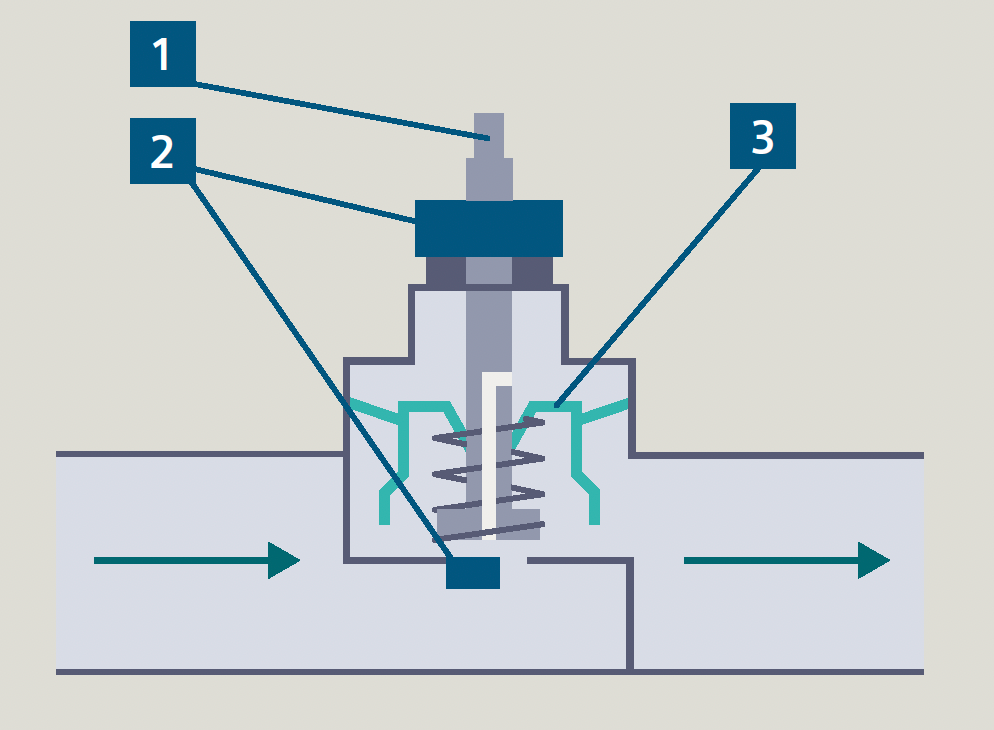
1. Flow control valve
2. Pre-setting
3. Differential pressure regulator
In heating and cooling applications in a building, the auto-balancing function generates energy savings in three different ways:
It eliminates heat exchanger overflow at anytime and under any operating condition.
It improves control accuracy by eliminating hydraulic cross-coupling between neighboring control loops.
It enables advanced energy distribution strategies by eliminating the risk of heat exchanger starvation.
How PICVs Improve Control Accuracy
PICVs eliminate overflows with dynamic-balancing
Hydraulic cross-coupling triggers variations of temperature in the building
Users shift the setpoint to reduce discomfort
PICVs nearly eliminate temperature variations
Full-stroke further increases control accuracy
Preventing the setpoint shift leads to energy savings
Application and Savings in a Real-Life Case Study
The three ways to generate savings described here were implemented in a campus with several buildings in a large Saudi Arabian city that has a representative number of heating and cooling days.

This building features air handling and fan coil units, with chilled water for cooling and electrical re-heaters for heating. The chilled water system incorporates the following components:
10 chillers. Located at utility building. Nine duty and one standby, capacity: 1370 kW each.
10 primary chilled water pumps, constant speed. Located at utility building. Nine duty and one standby, capacity: 55 l/s (198 m3/h) @ 30m head. The ratio of installed pump capacity and installed cooling capacity (chillers) is approximately 1.5%.
10 secondary chilled water pumps, variable speed. Located at utility building. Nine duty and one standby, capacity: 55 l/s (198 m3/h) @ 55m head. The ratio of installed pump capacity and installed cooling capacity (chillers) is approximately 2.5
Different sizes of air handling units (AHUs) and fan coil units (FCUs) located at each building as per demand cooling loads. Control valves with electrical actuators installed on the chilled water return pipes of the cooling units (AHUs and FCUs).
Up to 30% Savings with PICVs
Using actual operating and climatic data, energy savings were generated for both energy distribution and energy generation using the following three methods:
Eliminating heat exchanger overflow at any time and under any operating condition
Improving control accuracy by eliminating hydraulic cross-coupling between neighboring control loops
Enabling advanced energy distribution strategies by eliminating the risk of heat exchanger/cooling coils starvation
In this case, conservative calculations demonstrated that using PICVs in the building yielded savings of up to 25-30% in energy distribution and savings of 2-5% for energy generation.
In absolute annual figures, these savings amounted to approximately 330 MWh and approximately 200 MWh, respectively, or a total annual cost saving of around 34000 EUR.