
Control and Monitoring in Data Centers
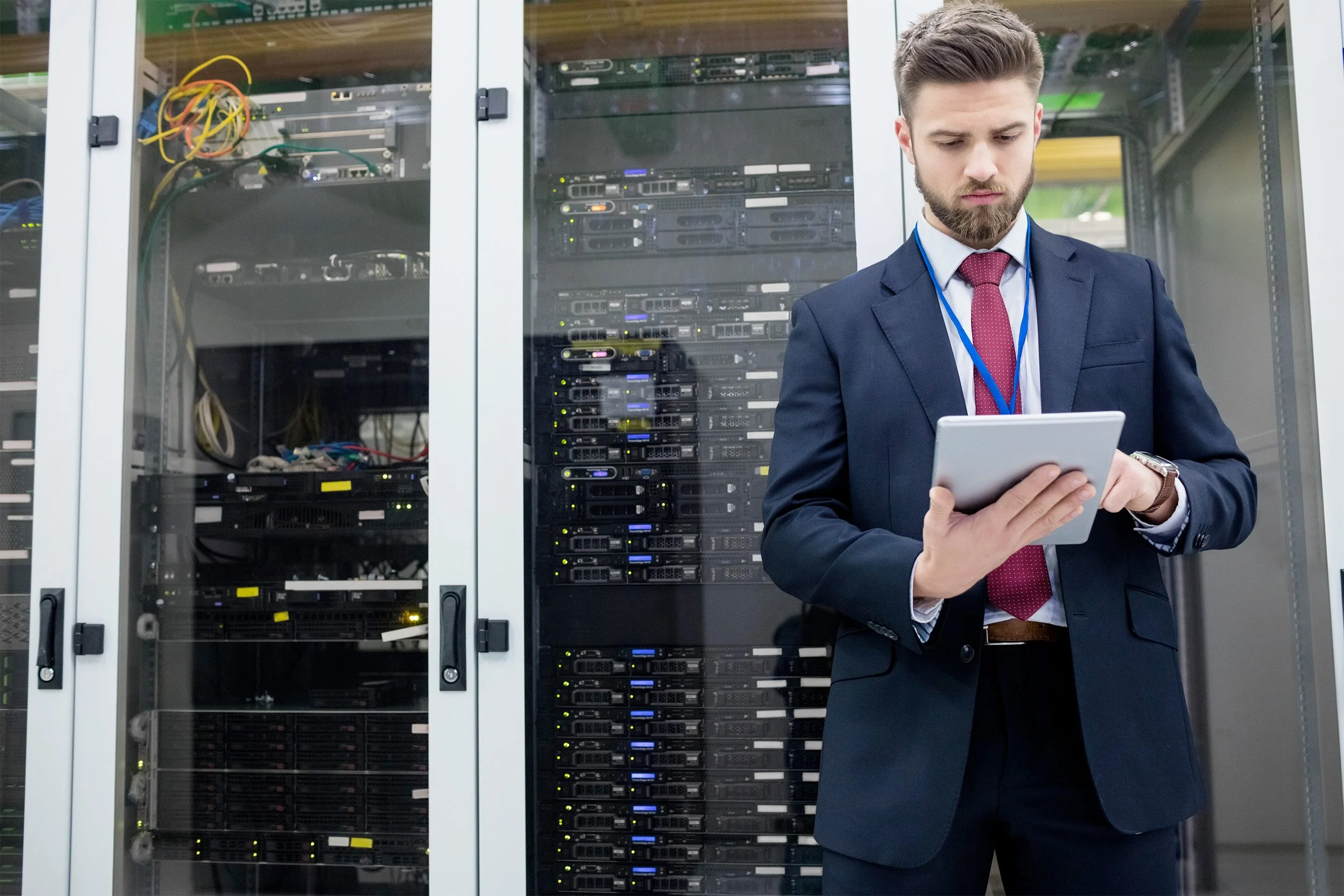
Reliable data center operation is not achieved with a single controller or sensor. It depends on layered control, independent safety limits, clean and trustworthy signals, environmental protection of electronics, and continuous monitoring across critical systems.
Cooling, airflow, power distribution, and environmental conditions must all remain within tight operating limits. When something drifts outside those limits, the system must respond correctly, without false alarms, noisy signals, or delayed action. The most resilient data centers achieve this by separating control, protection, and monitoring into clearly defined layers.
Control Systems
Control systems regulate the day-to-day operation of data center cooling and infrastructure. They continuously adjust outputs based on feedback from temperature, pressure, flow, and humidity sensors.
Typical control objectives include:
Maintaining supply and return air temperatures
Regulating chilled water or refrigerant flow
Managing fan speeds and valve positions
Coordinating multiple cooling zones and air handlers
Process controllers excel in this role because they provide precise closed-loop control using PID algorithms, configurable setpoints, and flexible outputs. They are designed to respond smoothly to changing loads, preventing oscillation and overshoot that could stress equipment or reduce cooling efficiency.
In a data center, controllers often interface with higher-level BAS or DCIM platforms, but they retain local autonomy to keep systems stable even if network communication is interrupted.
Series 16B Dual Loop PID Temperature Controller
The Series 16B Dual Loop PID Temperature Controller provides precise control for temperature and process applications using two independent control outputs. The Series 16B supports direct or reverse acting control and accepts universal inputs including RTDs, thermocouples, and process transmitter signals.
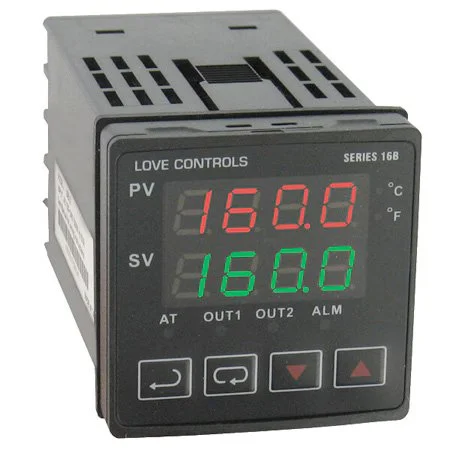
Series 16B Dual Loop PID Temp Controller
Dual LED displays provide clear indication of process value and setpoint, along with output and alarm status. The controller supports on/off, PID, and manual control modes, including ramp and soak programming with up to 64 actions. An integrated RS-485 interface allows communication with PCs and PLCs for system integration.
Key Features:
Dual loop control with two independent outputs
Universal input for RTDs, thermocouples, and process signals
On/off, PID, and manual control modes
Up to 64 ramp and soak program steps
RS-485 communication standard on all models
Dual LED displays with status indication
Two configurable alarm outputs
Scalability and digital integration with IO-Link conversion
Modern data centers are rarely static. New rack rows, cooling zones, and monitoring points are added over time. Traditional analog architectures make expansion costly and disruptive because each new device often requires:
Dedicated analog wiring
Controller reprogramming
Manual point mapping and commissioning
IO-Link conversion addresses these challenges by digitizing analog sensor signals and integrating them into a standardized IO-Link network.
Key advantages include:
Scalability
New sensors and devices can be added without reprogramming or re-terminating every controller. Additional devices connect through available IO-Link master ports or by expanding the IO-Link network, supporting phased data center growth.Simplified Commissioning
Analog signals are converted locally and transmitted digitally. This reduces individual analog terminations at controllers and centralizes data through an IO-Link master. Automatic device identification and standardized data formats accelerate system checkout and validation.Standardized Digital Integration
The link converter digitizes 4–20 mA or 0–10 V signals and transmits them over a wired IO-Link connection. From the IO-Link master, data is integrated into PLC, BAS, or DCIM platforms for centralized monitoring and control.
This approach preserves the accuracy of existing analog sensors while enabling modern, scalable digital architectures.
IF-IOL Series IO-Link Converters
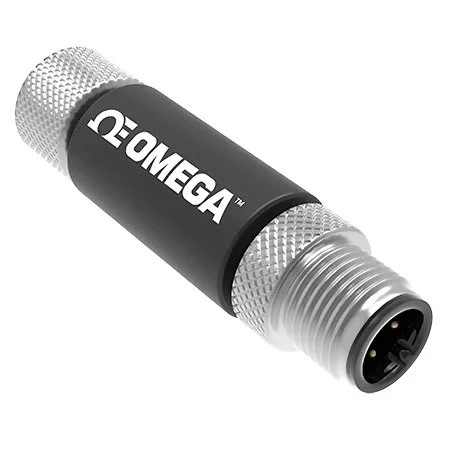
IF-IOL Series IO-Link Converter
The IF-IOL Series IO-Link Converters provide a simple way to integrate analog sensors into IO-Link systems. The IF-IOL Series converts standard 4 to 20 mA or 0 to 10 V signals into IO-Link process data, allowing legacy sensors to connect directly to IO-Link masters without additional hardware.
A rugged over-molded housing and compact in-line M12 connections support reliable operation in harsh industrial environments. LED indicators provide clear status feedback for power, IO-Link communication, and analog signal activity.
Key Features:
Converts 4 to 20 mA or 0 to 10 V signals to IO-Link
Compact in-line M12 connection for easy sensor integration
IP65, IP67, and IP68 rated over-molded housing
13 or 14-bit high-resolution signal conversion
LED indicators for power, IO-Link, and analog status
Protection: Hard Limits for Rare and Critical Events
Control systems are optimized for normal operation, but they are not intended to be the final safety barrier. Protection layers exist to handle rare, abnormal, or catastrophic conditions where immediate action is required.
Protection devices typically perform simple, deterministic actions such as:
Hard on/off shutdown
Alarm trip at a fixed threshold
Equipment lockout to prevent restart
These actions are intentionally independent of control logic, software, or network communications. If temperatures rise rapidly due to a failed valve, blocked airflow, or loss of cooling capacity, protection devices provide a hard stop before damage occurs.
In data center environments, this prevents:
Over-temperature damage to servers and power electronics
Thermal runaway in confined rack rows
Secondary failures caused by overheated infrastructure
By separating protection from control, data centers reduce the risk that a misconfigured controller or software fault could disable critical safety functions.
Series TSF-DF UL Thermocouple Limit Alarm with Relay Output
The Series TSF-DF Thermocouple Limit Alarm is a UL approved temperature limit control. The Series TSF-DF provides visual alarm indication and a relay output for safety shutdown or interlock functions.
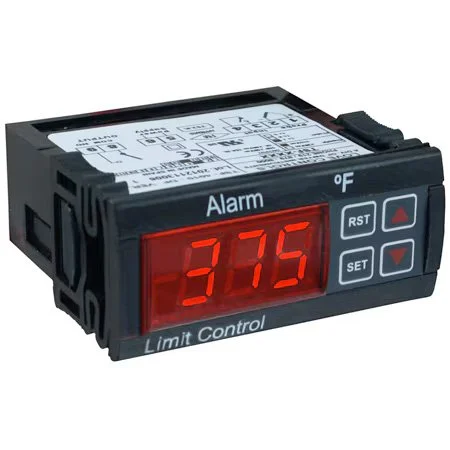
Series TSF-DF UL Thermocouple Limit Alarm
Programming cannot be performed on the device and requires a Series TSF-MDF programming control and a Series TS2-K configuration key.
Key Features:
UL approved limit control
Visual alarm indication
Relay output
Local and external reset capability
Fixed configuration for safety compliance
Protection: Extending Long-Term Reliability of Electronics
Protection is not limited to temperature limits. Long-term reliability also depends on protecting control panels and electronics from environmental contamination.
Data centers may appear clean, but control enclosures are still exposed to:
Fine dust from construction, retrofits, or raised floors
Airborne particulates drawn in by cooling airflow
Humidity fluctuations that promote corrosion or condensation
Over time, contamination can lead to overheating, tracking, corrosion, and intermittent failures inside panels. Dust controllers actively manage enclosure conditions by regulating airflow and pressure, helping prevent contaminants from entering sensitive electronics.
The result is:
Longer equipment life
Fewer unexplained controller or I/O failures
Reduced maintenance and unplanned downtime
This form of protection is preventative rather than reactive, but it plays a major role in long-term data center reliability.
Series DCT1000 Dust Collector Timer Controller
The Series DCT1000 Dust Collector Timer Controller is a modular control solution for pulse-jet dust collectors and pneumatic conveying systems that supports 6, 10, or 22 output channels and automatically detects connected channel expanders, allowing easy system expansion without replacing hardware.
The controller eliminates the need for external switches, relays, or timers and can operate in on-demand or continuous cleaning modes. Universal power compatibility supports both domestic and international installations.
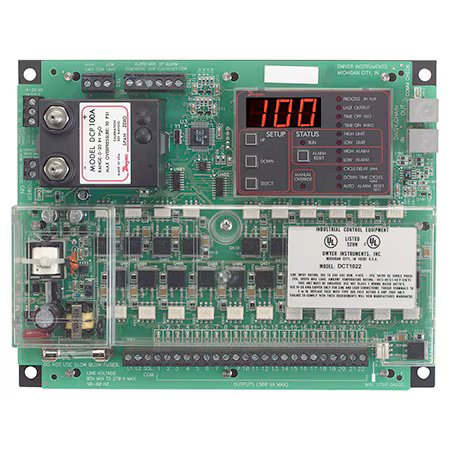
Series DCT1000 Dust Collector Timer Controller
Key Features:
Modular design with 6, 10, or 22 output channels
Automatic detection of connected channel expanders
On-demand or continuous cleaning operation
Universal power input for global use
Standard mounting compatibility with existing controllers
Eliminates external switches, relays, and timers
Protection: Eliminating Noise and Bad Data
Reliable control and monitoring depend on signal integrity. In data centers, sensors may be spread across long cable runs, different grounding zones, and electrically noisy environments filled with VFDs, UPS systems, and power electronics.
Without proper signal conditioning, systems may suffer from:
Electrical noise and interference
Ground loops
Signal drift or instability
False alarms and nuisance trips
Signal conditioners act as an isolation and stabilization layer between field devices and control systems. They clean and protect analog signals before they reach controllers, PLCs, or BAS inputs.
This ensures:
Controllers do not misread sensor values
Alarms do not false-trip due to noise
BAS points remain stable and trustworthy
Electrical problems do not propagate across systems
Signal conditioning protects both the data and the systems that depend on that data.
Series SC4 RTD and Thermocouple Signal Conditioners
Series SC4 Signal Conditioners provide linearized and fully isolated signal conditioning for RTD, thermocouple, and process signal inputs. The Series SC4 isolates input, output, and ground to protect control systems and improve measurement reliability in industrial panels.
Designed for easy installation on industry-standard 35 mm DIN rail, Series SC4 models offer high electrical isolation and field-selectable outputs. Low-voltage SCL units are also available for applications requiring reduced supply voltage.
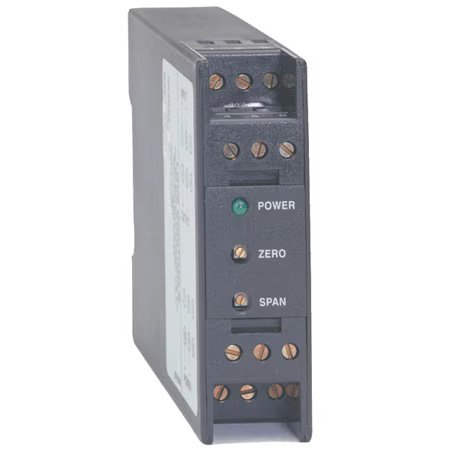
Series SC4 RTD & Thermocouple Signal Conditioners
Key Features:
RTD, thermocouple, and process signal conditioning
Up to 1500 VAC RMS electrical isolation
Linearized and isolated outputs
35 mm DIN rail mounting
Field-selectable output options (model dependent)
Low-voltage SCL versions available