The Hidden Cost of Imprecise Measurement in Data Centers
(Written by Vaisala in collaboration with Alps Controls)
Why sensor reliability is becoming a competitive advantage, not just a technical specification
Data centers are under pressure from every direction. AI workloads are driving unprecedented compute density. Energy costs are rising. Sustainability commitments are tightening. Regulators and investors are watching PUE and water usage numbers more closely than ever. In this environment, operators are investing heavily in cooling infrastructure, power systems, and efficiency software, and yet one of the most impactful variables in the equation is often the least scrutinized: the quality of the sensors feeding data into every control loop in the building.
A system is only as good as its inputs
Modern data center cooling relies on continuous measurement. Temperature, humidity, CO2, and dew point readings flow into building management systems (BMS) and direct digital controllers (DDC) to govern everything from chillers to airflow distribution. The precision of those control decisions is directly bound by the precision of the data coming in.
Consider a simple temperature example. In an air-cooled or hybrid-cooled white space, a sensor reading that runs even half a degree high (still within the tolerance of many commodity sensors) triggers the cooling system to work harder than necessary. Conversely, a reading that runs low risks under-cooling, with potential consequences for equipment uptime.
Research and real-world simulations have quantified this relationship concretely: a one-degree temperature deviation can shift data center cooling energy consumption by up to 8.5%. In a 10 MW IT load facility with a PUE of 1.25, almost 2 MW is dedicated to cooling. Even half of that potential waste, compounded over a decade, amounts to roughly 7 GWh, worth around one million dollars at typical energy prices for a single site.
Scale that figure across a global install base. Approximately 80% of the world's roughly 12,000 data centers still rely entirely or substantially on-air cooling. Eliminating a systematic half-degree measurement error across that install base would recover nearly 7 terawatt-hours annually, approximately one billion dollars in wasted cooling energy, every year.
The sensor is not the only factor. Controllers, sequences of operation, and system design all matter. But the sensor provides the first input. Everything built on top of it inherits its accuracy, or its error.
Accuracy at installation is not the same as accuracy over time
A specification sheet accuracy figure tells you how a sensor performs when it ships. It does not tell you how it performs in year two or year five, under real operating conditions. This distinction (stability, or long-term drift) is critical in environments where maintenance windows are scarce, and re-calibration cycles may be years apart.
Comparative testing tells a revealing story. Some sensors maintain full specification accuracy across three years of continuous operation with no measurable drift. Others deviate outside specification within months. A sensor that starts accurately but drifts steadily erodes control performance gradually and silently: the kind of degradation that doesn't trigger an alarm but shows up quietly in rising energy bills and unpredictable environmental conditions.
For humidity measurement, the stakes are equally significant. Excessively dry air in a data center creates static discharge risk. Too much humidity risks condensation on equipment. Humidity sensors that drift over time introduce the same compounding control errors as temperature sensors, harder to detect, and expensive to correct after the fact.
In environments where uptime is a contractual and reputational obligation, sensor drift is an operational risk that deserves explicit evaluation in the procurement process.
Cooling architecture is evolving, and so are instrumentation requirements
The industry is moving through a significant transition in how heat is managed. For decades, air cooling was the default architecture. It remains dominant: around 80% of data centers rely on it today. But as rack densities climb, particularly in AI training environments where a single rack may draw 50 kW or more compared to 5–10 kW in traditional workloads, air cooling alone is increasingly inadequate.
Hybrid cooling architectures, combining air handling with direct liquid cooling, are becoming the standard for high-density deployments. In these setups, coolant distribution units (CDUs) and computer room air handlers (CRAHs) work in concert, with liquid circuits handling the bulk of heat removal from processors while air manages residual heat and hot-aisle containment.
This architecture increases the number of measurement points and the diversity of parameters being monitored. Temperature and humidity remain central, but dew point measurement becomes critical in any environment where liquid cooling lines pass through spaces with varying humidity, as condensation on cold surfaces is a serious risk. CO2 monitoring matters for occupied spaces adjacent to or within the facility. The measurement layer must keep pace with cooling complexity.
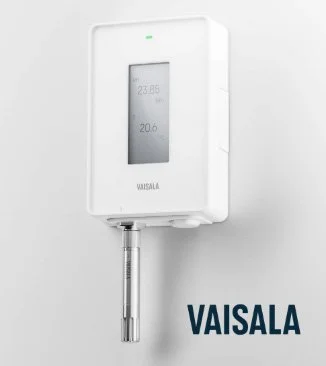
Modular, interchangeable measurement platforms are increasingly relevant here. When probe types can be swapped or added without replacing the transmitter infrastructure, it becomes far more practical to adapt instrumentation to evolving architectures, such as adding a dew point probe to an existing transmitter as liquid cooling is introduced, for example, rather than deploying entirely new hardware. Vaisala's ORIGO transmitter platform takes this approach: a unified transmitter body supports interchangeable probes covering temperature, humidity, CO2, and dew point, allowing the measurement configuration to evolve alongside the cooling architecture while maintaining a consistent BMS interface and device fleet.
Maintenance economics and total lifecycle cost
In large facilities with hundreds or thousands of sensors, maintenance is not a trivial operational burden. Calibration logistics, spare parts inventories, and technician training all accumulate into meaningful costs. Systems designed with maintenance friction in mind, with exchangeable probes that can be swapped in seconds, circulated through a calibration program, and rotated back into service, change the economics substantially.
There is also a fleet management argument. A standardized transmitter platform, regardless of which probes are attached, creates a uniform interface for BMS integration, reduces technician training requirements, and simplifies the management of device firmware and configuration across a large install base. The ORIGO platform illustrates what this looks like in practice: over 100 possible configurations built from a single transmitter body and a set of interchangeable probes, with probe swaps that take seconds rather than requiring hardware replacement. Where speed of deployment matters, and AI-driven expansion is pushing data center build timelines from years to months, modular, scalable instrumentation that supports daisy-chained Modbus field bus topologies can reduce installation labor, cabling material, and DDC panel IO count simultaneously.
Measurement as a sustainability lever
PUE optimization is often framed as a cooling infrastructure challenge: more efficient chillers, better airflow management, free cooling hours, heat recovery. These are significant levers. But they all depend on the same underlying measurement layer to be realized in practice.
The building automation system cannot optimize what it cannot accurately perceive. Precise, stable, long-term-reliable sensing is the foundational requirement for any energy efficiency program. In that sense, instrument quality is not a cost center; it is an enabler of the efficiency gains the facility is trying to achieve.
For operators navigating the intersection of rising power demand, sustainability targets, and rapid infrastructure evolution, the sensor layer deserves the same rigorous evaluation applied to any other critical system component. The cost of a better sensor is modest. The cost of a worse one compounds silently for years.